Beyond the Bundled Station: A Practical Buyer's Audit of On-Farm Weather Sensing
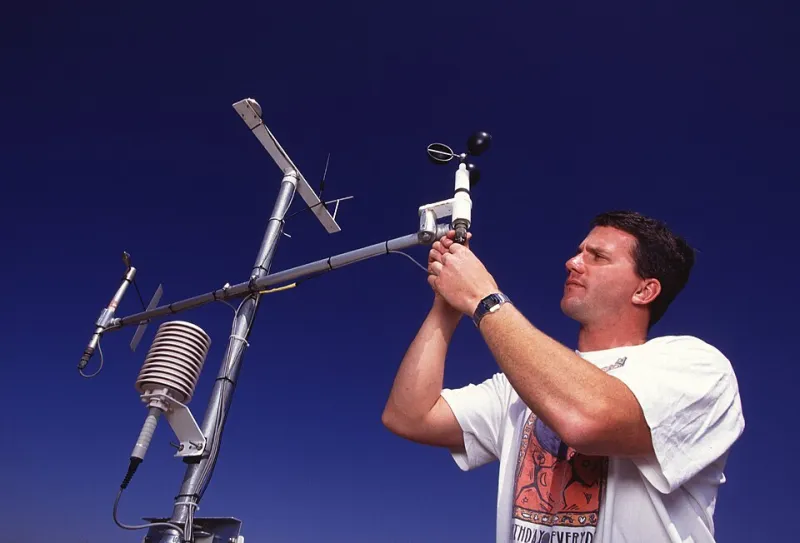
Photo: USDA photo by Scott Bauer. Image Number K7688-7, Public domain, via Wikimedia Commons
Somewhere between the seed order and the crop insurance paperwork, a new question has crept onto nearly every American farm's winter meeting agenda: whose weather station should we buy? Agricultural retailers, cooperatives, and even seed dealers now treat microclimate sensing as a standard attachment — bundled, discounted, and pitched with the same confidence as trait packages. The technology is genuinely useful. The sales environment around it, however, deserves scrutiny before a grower signs anything.
Why Every Counter Now Has a Sensor Pitch
The economics explain the enthusiasm. A modest weather station costs a retailer a few hundred dollars wholesale and carries recurring revenue through data subscriptions, maintenance plans, or premium app access. For co-ops facing margin pressure on agronomy services, hyperlocal weather is an attractive upsell: it feels high-tech, ties naturally to spraying and irrigation decisions, and locks a grower's data into a familiar platform.
There is real agronomic value behind the pitch. Rainfall measured at the field edge can differ dramatically from the gauge four miles down the road, and spray windows, disease models, and irrigation scheduling all improve when decisions rest on readings taken within sight of the crop. The problem is not the concept. It is the assumption that every bundled package delivers that value at a fair price.
Separating Accuracy From Marketing
Sensor quality varies more than most brochures admit. Three components matter most for field decisions:
- Rain gauges. Tipping-bucket gauges are convenient but underreport heavy Midwest downpours; weighing-type gauges cost more and measure more honestly. If disease modeling depends on your rainfall totals, gauge type is not a rounding error.
- Temperature and humidity. Radiation shielding quality drives accuracy far more than brand names. A $100 shield on a mid-tier sensor can outperform a premium station with poor housing.
- Leaf wetness and soil moisture probes. These add-ons justify subscription tiers, but a grower running dryland acres may never recoup the cost.
Before comparing brands, write down the decisions the station must support. A grower scheduling pivot irrigation in Nebraska needs different instrumentation than an orchardist tracking chill hours in Washington. Buying beyond that list is where bundled packages quietly inflate.
The Subscription Math Nobody Reads Aloud
Hardware prices anchor the conversation, but the total cost of ownership lives in the fine print. A $400 consumer-grade station with a free app can, for many row-crop operations, deliver 80 percent of the decision value of a $4,000 research-grade installation. The gap closes — sometimes reverses — once subscriptions enter the picture.
Ask three questions of any proposal. First, what does the data feed cost annually, and does it escalate after an introductory period? Second, who owns the raw readings if you leave the platform, and can they be exported in a usable format? Third, is the station functional offline, or does every alert route through a paid cloud service? Growers who signed multi-year data agreements during the last hardware cycle have learned these questions the expensive way.
Network Density: The Neighbor Effect
One station on one field is useful. A dense network across a township is transformative — shared frost alerts, localized hail verification for insurance claims, and spray windows that reflect actual conditions rather than the nearest airport. Some of the strongest deals available to growers today are not purchases at all but participation arrangements: regional networks where a co-op or land-grant partnership aggregates member stations and shares the analytical load.
Before buying standalone, ask whether a neighboring network exists. Contributing your data to a shared platform may reduce your hardware cost, improve regional model accuracy, and spare you from maintaining another subscription. The counterargument — data exclusivity — is legitimate and worth weighing against the site's ongoing argument that field information deserves the same ownership discipline as land itself.
A Practical Decision Framework
For growers sifting through this season's catalogs, a simple audit helps:
- Match the sensor to the decision. Spray timing, irrigation, and frost protection each demand different instrumentation. Buy for the decision, not the dashboard.
- Price five years, not one. Hardware plus subscriptions plus maintenance, compared against the value of one avoided misapplication or one better-timed irrigation set.
- Interrogate the bundle. If the station arrives attached to a financing or agronomy contract, price it standalone before accepting the package rate.
- Check the exit. Export rights, API access, and what happens to historical data at contract's end.
- Look sideways before looking up. A neighbor's station, a regional network, or a public mesonet may cover part of the need at a fraction of the cost.
The Bottom Line for the Modern Grower
Hyperlocal weather sensing has earned its place in precision agriculture. The tools are better and cheaper than they were a decade ago, and the agronomic case is sound. But the current sales climate — every retailer, every bundle, every app tier — rewards growers who slow down and buy deliberately. The best station on your farm is the one whose accuracy you have verified, whose costs you can forecast, and whose data you still control when the sales rep moves on to the next territory.