Picking by the Pound: What Subscription Robotics Actually Costs a Strawberry Grower
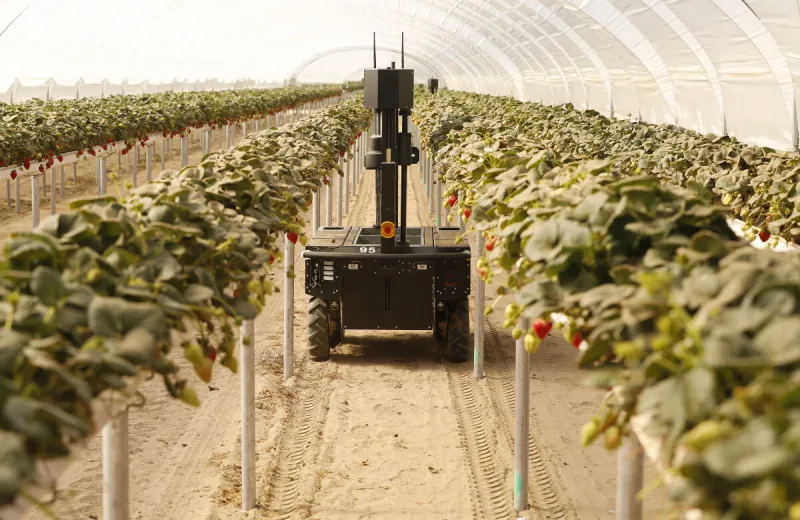
Photo: robotic strawberry harvester machine in California field, via ca-times.brightspotcdn.com
For most of the last century, the arithmetic of harvest was simple: you needed hands, you needed housing or a labor contractor, and you needed enough cash flow to cover both. That arithmetic is now being challenged by a different kind of machine — one that bills you monthly, promises to show up on time, and never asks about immigration paperwork.
Robot-as-a-service (RaaS) harvest platforms are no longer a laboratory curiosity. Companies deploying robotic pickers in California strawberries and Washington tree fruit have shifted from selling six-figure machines to leasing them by the acre, by the season, or by the pound. For growers squeezed by a labor supply that has tightened every year since 2020, the pitch is seductive. The question is whether the numbers hold up in the field.
The Subscription Model Comes to the Field
Under a typical RaaS agreement, a grower pays an upfront mobilization fee — often in the $10,000 to $25,000 range per unit — followed by a per-acre or per-hour charge through the harvest window. One strawberry operator in the Salinas Valley described the structure plainly: "It's like a combine custom operator, except the combine picks one berry at a time."
The economics hinge on three variables:
- Speed. Current strawberry robots pick at roughly 30 to 60 percent of a skilled human crew's pace, though they can run longer hours and in more conditions.
- Damage rates. Fruit handling has improved dramatically, but bruising and missed calyx removal still cost some growers a packout percentage they must price in.
- Selectivity. In apples, platforms with vacuum or soft-gripper systems perform best on high-density blocks trained specifically for machine access.
When we run the comparison, a human picking crew might cost a specialty crop grower $3,000 to $5,000 per acre in a difficult year — if the crew shows up at all. Subscription robots currently land somewhere between $2,500 and $6,000 per acre depending on crop, yield, and the length of the contracted window. The robot wins on predictability, not necessarily on price.
What Growers Who've Tried It Say
A third-generation apple grower near Yakima, who asked not to be named because his RaaS contract includes a confidentiality clause, put it this way: "We ran two platforms last season on about forty acres. We didn't save money. We saved the harvest. Without them, we'd have left fruit on the trees."
That distinction matters. In a tight labor market, the alternative to a robot is not cheap labor — it is unpicked fruit. Several Washington growers reported letting late-season blocks go unharvested in 2022 and 2023, a loss that makes a $4,000-per-acre robot bill look like insurance rather than a luxury.
Strawberry growers report a similar calculus with a wrinkle: robots excel at night shifts and in heat events when human crews thin out. One Oxnard-area grower noted his leased units kept working through a September heat wave that sent his contracted crew home by 10 a.m.
The Cultural Ledger
There is a number no spreadsheet captures. The seasonal workforce that harvests America's specialty crops has been part of rural communities — from Watsonville to Wenatchee — for generations. Growers interviewed for this piece were careful, sometimes uncomfortable, on the subject.
"I don't want to be the guy who ended an industry," one Salinas grower said. "But I also don't want to be the guy who lost the farm because nobody came."
Labor advocates caution that RaaS contracts often displace the very workers facing the greatest barriers to legal employment, while some economists argue that mechanization historically shifts workers into adjacent roles — maintenance, machine operation, canopy management — rather than eliminating them outright. Both things can be true at once, and neither resolves the tension.
The Road to 2030
Several credible forecasts suggest robotic harvesters could handle a meaningful share of high-value specialty crops by the end of the decade — perhaps 20 to 30 percent of strawberries in machine-adapted production systems, and a smaller fraction of apples given the capital cost of retraining orchards. Those figures depend less on the robots than on the orchards and beds themselves: standardization, spacing, and cultivar choice will decide adoption as much as gripper engineering.
For growers weighing a first contract, the advice from early adopters is consistent: negotiate per-pound pricing if you can, insist on damage guarantees, and run the machines on your worst ground, not your best. The technology is real. Whether the subscription pays depends on whether your harvest was going to happen at all.