The Data Deed: Why American Growers Must Treat Field Information Like the Land Itself
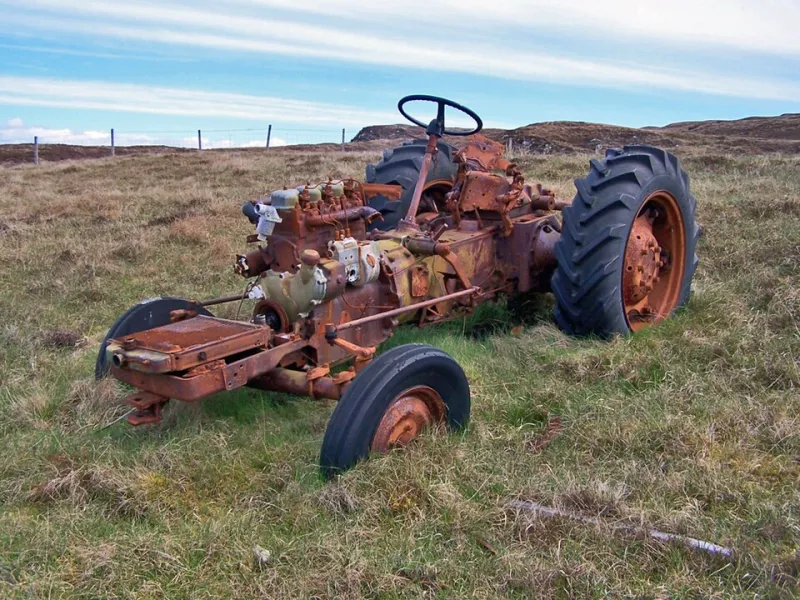
Photo: Richard Dorrell, CC BY-SA 2.0, via Wikimedia Commons
Here is an uncomfortable question that most American farmers have never been asked directly, even though they answer it implicitly every time they start a modern tractor: Who owns the record of your fields?
Not the crops. Not the equipment. The data — the yield maps, the planting populations, the as-applied rates, the soil test results, the machine telemetry streaming off a combine at 4 a.m. during harvest. If your instinctive answer is "I do," the current state of the industry suggests you may be mistaken.
The Quiet Land Grab
A single season on a 2,000-acre row-crop operation can generate terabytes of agronomic and machine data. That information has real market value. It can be aggregated to build predictive models for commodity traders, sold to input suppliers for targeted marketing, licensed to crop insurance actuaries, or used to train the very algorithms that equipment manufacturers will later sell back to growers as premium subscription services.
And here is the problem: in most cases, the farmer never explicitly agreed to any of this. They clicked through a terms-of-service agreement — hundreds of pages, non-negotiable — on a dealership computer. Industry surveys have repeatedly found that a majority of growers cannot identify who holds the rights to their farm data, and a substantial share assume that ownership defaults to them. It does not, at least not automatically.
The American Farm Bureau Federation and various commodity groups have pushed for clearer data ownership principles, and some manufacturers have adopted voluntary codes of conduct. But voluntary codes are not property rights. They are promises that can be revised.
Right to Repair Is Really Right to Data
The right-to-repair fight — exemplified by years of legislative efforts in states like Nebraska, Iowa, and Missouri, and by the eventual memorandum of understanding between manufacturers and farm groups — has been framed almost entirely as a matter of wrenches and diagnostic software. Farmers want to fix their own machines without waiting for a dealer technician.
But look one level deeper. Restricted access to repair tools and diagnostic systems exists partly because machine data is the chokepoint through which manufacturers maintain control of the relationship — and the revenue — after the sale. Whoever controls the diagnostic port controls the data stream. Whoever controls the data stream controls the customer.
When John Deere and other manufacturers negotiate data licensing arrangements with third parties — agtech platforms, financial services firms, sustainability programs paying for verified practice changes — the farmer is frequently the source of the data but not a party to the transaction. That inversion should trouble anyone who believes in the independence that defines American agriculture.
The Analogy That Should Guide Policy
Start with a principle every grower already understands: crop insurance. No lender, no landlord, no grain buyer would ask a farmer to hand over insurance proceeds or sign them away in a boilerplate contract. The indemnity belongs to the grower because the risk belonged to the grower.
Field data deserves the same status. The farmer bore the risk, made the decisions, and paid for the inputs that generated it. Any value derived downstream should flow back through a transparent, consent-based transaction — not be captured silently as a condition of operating equipment the farmer purchased outright.
Concretely, this means three things:
- Contractual ownership clauses. Growers should insist on written agreements stating that agronomic data remains the property of the operation, with licensing terms that are explicit, revocable, and compensated.
- Portability. Data should be exportable in standard formats at no charge. Lock-in is leverage, and leverage belongs to the customer.
- A seat at the table. Commodity organizations and land-grant universities should push for model data contracts — the same way standard lease agreements were standardized for land rental decades ago.
The Counterargument — and Why It Fails
Equipment makers will say that aggregated data benefits everyone: better agronomic models, improved machine performance, more accurate weather and yield predictions. There is truth in that. But benefiting from aggregated data and owning the underlying asset are not mutually exclusive. Landlords benefit from productive tenants; that doesn't transfer the deed.
Others will argue that farmers who care can simply opt out. In practice, opting out of a major manufacturer's data terms often means forgoing functionality — auto-guidance features, remote monitoring, connectivity — that modern operations reasonably require. An opt-out buried in functionality is not consent. It is coercion dressed in fine print.
A Non-Negotiable Standard
American agriculture has always organized itself around the principle that the person who works the land holds the stake in it. That principle is now being tested in a domain the founding generation never imagined. The answer, though, can be the same one growers apply to every other asset on the farm: know what you own, know what you're signing away, and refuse terms that treat your information as someone else's inventory.
Field data is not exhaust. It is the digital equivalent of the soil itself — accumulated, valuable, and worth defending. It is time the contracts, the statutes, and the industry norms caught up to that simple fact.