Right-Sized Tech: How Mid-Sized American Farms Are Closing the Precision Gap Without Enterprise Budgets

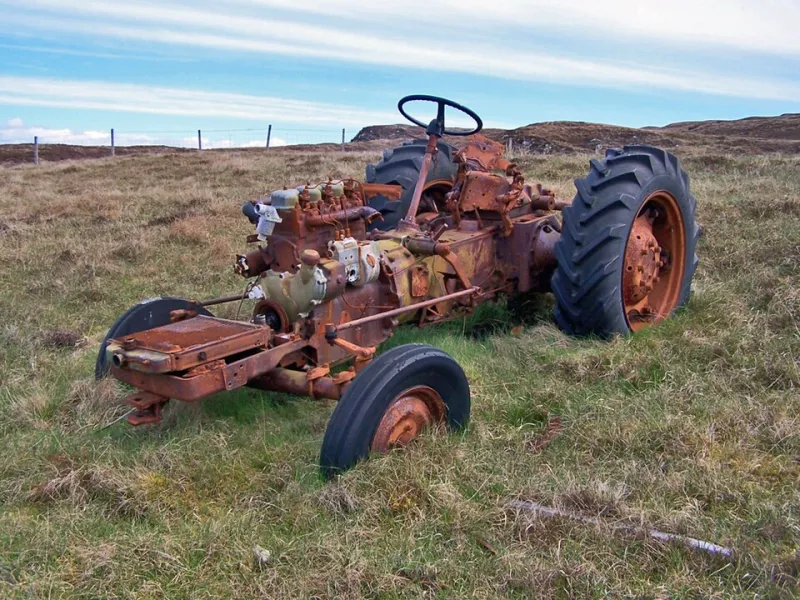
Photo: Osama Shukir Muhammed Amin FRCP(Glasg), CC BY-SA 4.0, via Wikimedia Commons
For decades, agricultural technology has followed a familiar pattern: innovations debut on sprawling operations in the Corn Belt, trickle down through early adopters, and eventually reach everyone else. But the middle has been left behind. Farms in the 100-to-1,000-acre range — a segment that describes tens of thousands of operations across Iowa, Nebraska, Indiana, and beyond — often can't justify a $150,000 integrated precision platform, yet they're far beyond the reach of backyard-scale solutions.
That gap is finally narrowing, and the catalyst isn't a breakthrough in satellites or AI. It's affordability.
The Economics of the Middle
Enterprise-level precision ag programs typically assume thousands of acres over which to amortize hardware, software subscriptions, and agronomic consulting. On a 600-acre row-crop operation in central Illinois, a full-stack platform costing $200 per acre annually in combined costs can consume a meaningful share of already-thin margins — particularly in years when commodity prices soften.
The alternative that's emerged is what early adopters are calling "right-sized tech": individual tools that solve one problem well, at a price point recoverable within one to three growing seasons.
Soil Sensors That Pay Their Way
Consider the case of a diversified grain operation in southeastern Minnesota that installed a network of twelve capacitance-based soil moisture and EC probes across its 480 acres. Total outlay, including a subscription dashboard: roughly $4,200 in year one.
The payoff came in two forms. First, variable-rate nitrogen application guided by sensor readings cut fertilizer spend by an estimated 9 percent — approximately $3,800 in a single season. Second, the operation avoided a predicted yield loss in a low-lying field by catching drainage issues two weeks earlier than visual scouting would have allowed.
"The technology itself isn't new," the farm's operator notes. "What's new is that I didn't need a bank loan to try it. I put it on 40 acres first, proved it, then scaled."
That staged approach — the so-called 5-acre experiment — has become a de facto methodology among cautious mid-sized growers. Test small, measure honestly, expand only on evidence.
Drones: From Toy to Tool
Multirotor drones with multispectral cameras have followed a similar trajectory. A capable NDVI-equipped platform now costs under $3,500, a fraction of the aerial imagery service fees that once made regular crop scouting flights impractical for smaller operations.
Growers in Kansas and the Dakotas report using weekly drone flights primarily for early detection of SDS in soybeans, nitrogen deficiency streaks, and hail damage documentation for insurance claims. The insurance documentation angle, in particular, has proven unexpectedly valuable — one Kansas producer credits drone imagery with strengthening a crop insurance claim by more than $11,000 after a 2023 hailstorm.
GPS Retrofits and the Right-to-Repair Effect
Perhaps the most consequential shift involves guidance systems. Rather than trading up to a new planter with factory-installed autosteer, many mid-sized farms are retrofitting older equipment with aftermarket GPS kits priced between $1,500 and $8,000.
The ongoing right-to-repair movement — including memorandums of understanding between major manufacturers and farm organizations — has indirectly accelerated this trend by making it easier for independent dealers and third parties to service and integrate retrofit hardware. A 25-year-old tractor converted to sub-meter guidance delivers most of the pass-to-pass accuracy benefit of a new machine at less than a tenth of the cost.
The USDA Cost-Share Lever
Federal programs have quietly become a meaningful accelerant. The Environmental Quality Incentives Program (EQIP) and various state-level conservation initiatives now fund soil testing, sensor installations, and precision nutrient management planning. Under EQIP, cost-share rates can cover 50 to 75 percent of eligible conservation practice costs, and several Natural Resources Conservation Service (NRCS) state offices have explicitly listed precision agriculture technologies among eligible activities.
Additionally, the USDA's Rural Energy for America Program (REAP), while energy-focused, has supported on-farm technology upgrades that reduce fuel consumption — a category that includes guidance systems that cut overlapping passes.
Advisers recommend that growers start with their local NRCS office before purchasing anything. Timing matters: EQIP applications follow annual batching deadlines, and a well-documented conservation plan strengthens an application considerably.
A Sober Look at ROI
None of this should suggest that every gadget pays for itself. Independent analyses consistently show wide variance in returns depending on field variability, cropping system, and operator discipline. Variable-rate technology, for instance, tends to deliver its strongest returns on fields with documented soil heterogeneity — which is precisely why soil mapping should precede, not follow, hardware purchases.
The realistic framework for a mid-sized operation looks like this:
- Year one: Baseline soil testing and mapping, one low-cost sensor network, manual record-keeping upgraded to digital.
- Year two: Drone scouting program, targeted variable-rate application on the most variable fields.
- Year three: GPS retrofit of primary equipment, informed by two seasons of data.
Staggered this way, annual technology spending rarely exceeds $5,000–$7,500 — a level most mid-sized operations can absorb without financing, and one that USDA programs can meaningfully offset.
The Bigger Picture
The quiet story here isn't any single device. It's that the barrier to entry in precision agriculture has dropped from enterprise-level capital commitment to a few thousand dollars and a willingness to experiment on a handful of acres. For America's mid-sized farms — the backbone of rural economies from Ohio to Oregon — that changes the calculus entirely.
The operations that thrive won't be the ones that buy the most technology. They'll be the ones that test it deliberately, measure it honestly, and scale only what the data supports. In precision agriculture, as in farming itself, patience remains a virtue — and now, finally, it's also affordable.