Line Items and Low Yields: An Iowa Grower Tears Up His Ag-Tech Subscription Stack
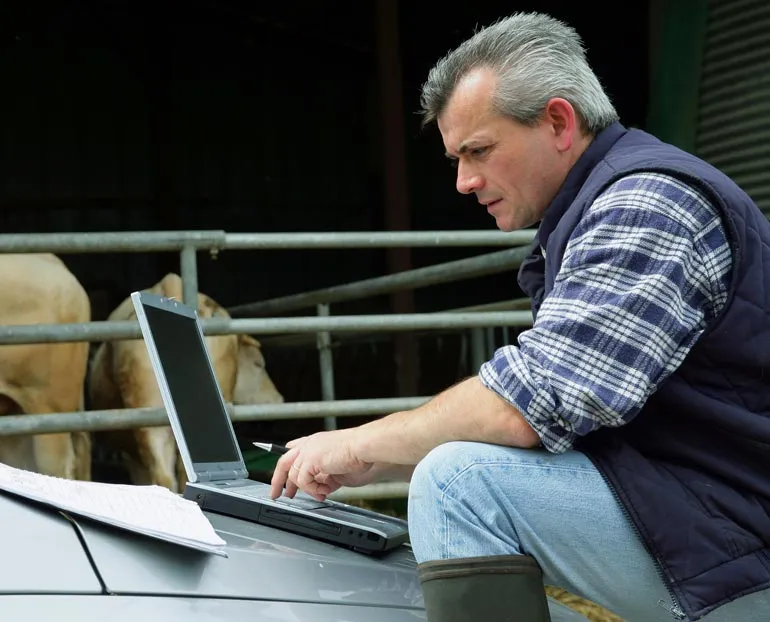
Photo: farmer reviewing finances laptop spreadsheet farm office, via www.farmcrediteast.com
The spreadsheet arrived in my inbox on a Tuesday morning in February, and even for a grower who had spent eight years preaching data-driven decision-making, it was humbling. Darin Voss, who farms 2,100 acres of corn and soybeans near Nevada, Iowa, had done something almost nobody in precision agriculture does: he had itemized every recurring software charge on his operation and stacked it against the returns he could actually prove.
The total stopped me cold. $31,412 a year. Recurring. Whether it rained or not.
The Stack Nobody Talks About
Voss's operation runs on what he calls "the invisible payroll" — a collection of subscriptions that each seemed reasonable at signup and, together, had grown into one of his largest input line items, sitting just below fertilizer and crop protection.
The breakdown, which he shared in full:
- Agronomy decision platform: $9,600 annually, priced per acre across his corn ground
- Fleet and equipment telematics dashboard: $4,200, bundled with a mixed John Deere and Case IH fleet
- Cloud data storage and backup: $2,150, accumulated over four years of yield monitor files, as-applied maps, and drone imagery
- Hyperlocal weather feed: $1,800, replacing a free service he abandoned after two bad spray-window calls
- Grain marketing and position-tracking app: $3,000
- Field scouting imagery service: $5,400
- Accounting and recordkeeping software with agronomic modules: $2,800
- Assorted smaller tools — a tissue sampling app, a tank-mix calculator, a land parcel mapper: $2,462
"I never set out to spend thirty-one thousand dollars on software," Voss said. "It was nine hundred here, twelve hundred there. Every one of them had a demo that made sense. The problem is nobody ever comes back to ask whether the sense held up."
Cost Per Acre: The Number That Changes the Conversation
Divided across 2,100 acres, Voss's stack came to $14.96 per acre — a figure he had never calculated until we sat down with his credit card statements in January.
"When you tell me a platform costs $9,600, my eyes glaze over," he said. "When you tell me it's $4.57 an acre, now I'm asking what that platform did to earn it."
That reframing is where the audit got uncomfortable. Working through each line, Voss could document a measurable return on exactly three subscriptions: the weather feed, which he credits with saving two fungicide applications in 2023; the fleet dashboard, which cut unauthorized after-hours equipment use and idle time enough to justify itself; and the recordkeeping platform, which pays for itself in reduced audit stress and FSA paperwork alone.
The other five? "Feel-good spend," in his words. The scouting imagery service overlapped almost entirely with what his agronomist already provided. The grain marketing app duplicated functions in his lender's portal. The decision platform, he admits, "mostly confirmed what I already suspected."
The Three-Question Test
Voss's audit boiled each subscription down to three questions, and his answers are instructive:
1. Can I point to a decision this changed? Not supported, not informed — changed. If a tool never altered a planting rate, a spray date, or a marketing position, it is decoration.
2. Does it duplicate something I already pay for? Voss found roughly $8,000 in functional overlap across his stack, including two services that both generated variable-rate prescriptions from the same underlying data.
3. Would I sign up again today, at today's prices? The renewal email is where most subscriptions die. Voss's rule now: every tool gets re-sold to him annually, or it gets cut. Five didn't survive the re-sell.
What He Cut, and What It Saved
By mid-March, Voss had cancelled four subscriptions and negotiated a per-acre reduction on a fifth, bringing his annual recurring spend to $18,900 — a 40% reduction, or about $5.97 per acre retained rather than spent.
He reinvested a portion in something he had been putting off: a paid calibration and sensor-health check across his yield monitors and flow sensors. "Turns out my data quality problem wasn't a software problem," he said. "It was a hardware problem the software kept quietly papering over."
Run the Audit Yourself
To that end, we've built a simple audit template — a spreadsheet with tabs for every recurring charge, cost per acre, renewal date, and a three-question justification field for each tool. Download it, pull your last twelve months of card statements, and be honest with the justification column.
Voss's closing advice is blunt: "Software companies sell you the dream of the dashboard. Nobody sells you the discipline of the cancellation. That part's on you."
For a publication built around precision farming, it's a useful reminder that the sharpest tool on any operation is a line item questioned on time.