Signed, Sealed, Submerged: The Contract Clauses That Turn Smart Irrigation Into a Costly Lesson
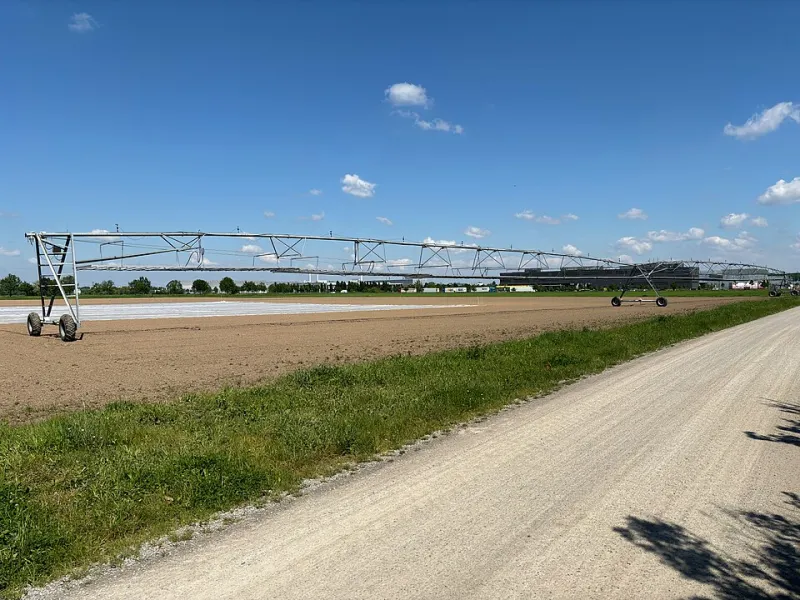
Photo: Killarnee, CC BY-SA 4.0, via Wikimedia Commons
The pitch usually arrives on a pleasant spring afternoon: a vendor demonstration of variable-rate irrigation (VRI) hardware, soil-moisture probes streaming data to a phone, and a promise that precision water management will pay for itself within a few seasons. For growers across the High Plains and the inland valleys of the West, the arithmetic can seem straightforward. Water is expensive, allocations are tightening, and anything that trims pumping hours looks like found money.
What the demonstration rarely includes is a careful reading of the contract itself. Interviews with growers in Nebraska, Colorado, and the Central Valley of California reveal a pattern: the technology generally works as advertised, but the agreements surrounding it — water rights, pump retrofits, data ownership, and termination terms — are where the real costs hide.
The Retrofit Nobody Quoted
A VRI retrofit on a center pivot sounds like a bolt-on job. In practice, growers report, the quoted package often covers the nozzle hardware and the control panel while leaving out the electrical service upgrades, pressure regulators, and pump modifications that older systems require.
A Nebraska grower who runs 320 acres under a twenty-year-old pivot described receiving a bid for the VRI conversion, then a second bid — roughly forty percent higher — for the pump and panel work needed to make the first bid function. "Nobody lied to me," he said. "They just never mentioned the other half."
Contract language matters here. Agreements that specify "supply and installation of VRI components" leave room for the integrator to treat the hydraulic and electrical groundwork as a separate engagement. Growers reviewing such contracts should insist on a scope document that names every component between the mainline and the last nozzle.
Water Rights and the Fine Print of Savings
In much of the West, saving water is not the same as keeping water. Under prior appropriation doctrine in states like Colorado and Idaho, water saved through efficiency can complicate a grower's diversion record, and in some basins, conserved water becomes subject to administration rather than automatic reuse.
Several growers learned that a VRI system's documented savings — the vendor's own dashboards prove the reduction — can be entered into evidence during water court proceedings or lease negotiations. One Colorado grower noted that the same data that justified the investment on his lender's desk became a talking point when a neighboring municipality came shopping for transfers.
The lesson is not to avoid metering, but to understand what the data proves and who can access it. Contracts that grant vendors broad rights to aggregate and share field data deserve the same scrutiny as any other data agreement, and growers should confirm whether efficiency gains must be reported to any state or district authority.
Per-Acre-Foot Reality Check
Vendors commonly quote savings as a percentage of pumping. Growers who have run smart irrigation systems for multiple seasons suggest converting that percentage into dollars per acre-foot before signing.
The calculation is simple: take the promised reduction in applied water, multiply by the district's delivered rate or the energy cost of pumping, and compare the result against the full annual cost — hardware amortization, subscription fees, sensor maintenance, and calibration labor. In districts where delivered water runs $75 to $150 per acre-foot, the math can work cleanly. Where the marginal cost of water is low and energy is cheap, payback periods stretch well past the useful life of the electronics.
Subscription terms deserve particular attention. Several growers described automatic-renewal clauses with 60- or 90-day cancellation windows, effectively locking in another season's fees before planting decisions were even made.
A Plain-English Checklist
Growers evaluating a smart irrigation contract can use the following questions as a starting point:
- What exactly is quoted? Demand a component-level list covering pumps, panels, wiring, and regulators — not just nozzles and software.
- Who owns the water data? Confirm that field records, usage logs, and efficiency calculations belong to the grower, and that vendor sharing requires written consent.
- Does the contract survive the hardware? If the subscription lapses, does the pivot revert to manual control or become a paperweight?
- What is the true annual cost? Add subscriptions, sensor replacement, and calibration time to the amortized hardware cost, then compare against realistic per-acre-foot savings.
- Are savings reportable? Ask whether the system's data could be disclosed to districts, courts, or third parties, and whether the contract limits that exposure.
- What is the exit? Note renewal windows, removal costs, and whether proprietary controllers can be replaced with third-party equipment.
Precision, But on Your Terms
None of the growers interviewed regretted adopting variable-rate irrigation outright. Most said the technology delivered real savings during dry years and gave them a defensible record of stewardship. The regret centered on sequencing — signing before the pump was inspected, before the water attorney read the data clause, before the per-acre-foot math was done on paper rather than in a sales presentation.
Precision water is a sound idea arriving through an immature contracting culture. Until vendors standardize their agreements, the burden of due diligence falls on the grower. Read the scope, price the whole system, and treat the data clauses with the same care as the land itself.